Law · AI transparency
Labelling AI content under the EU AI Act: when and how

More of the content we read, watch and chat with online is made or shaped by AI. The EU AI Act (Regulation (EU) 2024/1689) sets transparency rules in Article 50 so people are not misled about that. Here is a plain-language guide to when AI-generated text, images and chatbots need a label, and when they do not.
This is general information, not legal advice. Rules are applied to specific situations, so for your own case check the official sources linked below or ask a qualified adviser.
The EU AI Act (Regulation (EU) 2024/1689) includes transparency obligations in Article 50. The core idea is simple: do not mislead people. When there is a real risk of confusion or manipulation, the public has a right to know that content is machine-made.
For most business and blog text there is a key exception: if a human reviews and approves the substance and takes editorial responsibility, no label is required. For realistic images of real people or events, and for chatbots, disclosure is expected. Obvious illustrations and stylised graphics are not.
Below you will find a labelling table, a practical checklist and answers to the questions people ask most, so you can publish AI-assisted content with confidence.
What does the EU AI Act require about transparency?
The EU AI Act, Regulation (EU) 2024/1689, sets out transparency obligations in Article 50. The heart of it is preventing deception: when content is machine-generated and there is a genuine risk of confusion or manipulation, the audience should be able to tell that it is the work of a machine. Because the Act applies directly across the EU, this concerns anyone publishing content to a European audience.
The Act does not demand a warning label on every AI-touched sentence or pixel. It targets situations where a reasonable person could be misled about what they are seeing or who they are talking to. That is why the rules land differently for a blog post, a photo-realistic image of a real politician, and a chatbot. The sections below take each in turn.
When does AI-generated text need a label?
Text that is fully AI-generated and concerns matters of public interest, such as society, politics, health, safety or justice, should be clearly labelled. But the most important exception covers most everyday business writing: if a person reviews and approves the substance, and takes editorial and legal responsibility for it, no label is required.
This exception matters because it describes how most blog posts and company pages are actually made. A human decides the message, checks the facts and signs off before publishing. In that workflow the machine is a tool and a person is answerable for the result. That is very different from a light proofread: running a spell check over an AI draft and hitting publish does not give you editorial responsibility for the content.
If you do need to label a text, keep it plain and put it where readers will see it. A short line at the top or bottom such as "This text was generated with AI" is enough. The goal is honesty, not a legal disclaimer buried in a footer.
When do AI images and video need a label?
For images and video, realism is the deciding factor. Photo-like visuals of a real person, place or event that a viewer could reasonably mistake for genuine follow the deepfake principle and should be clearly labelled. Obviously fictional or stylised visuals, such as illustrations, abstract art, 3D vector or sci-fi scenes, do not need a visible label.
The test is whether someone could take the image for a real photograph. A synthetic but convincing picture of a named person at a real event risks misleading people, so it needs a clear mark. A cartoon mascot, a decorative gradient or a clearly artificial 3D render does not, because nobody would mistake it for documentary evidence.
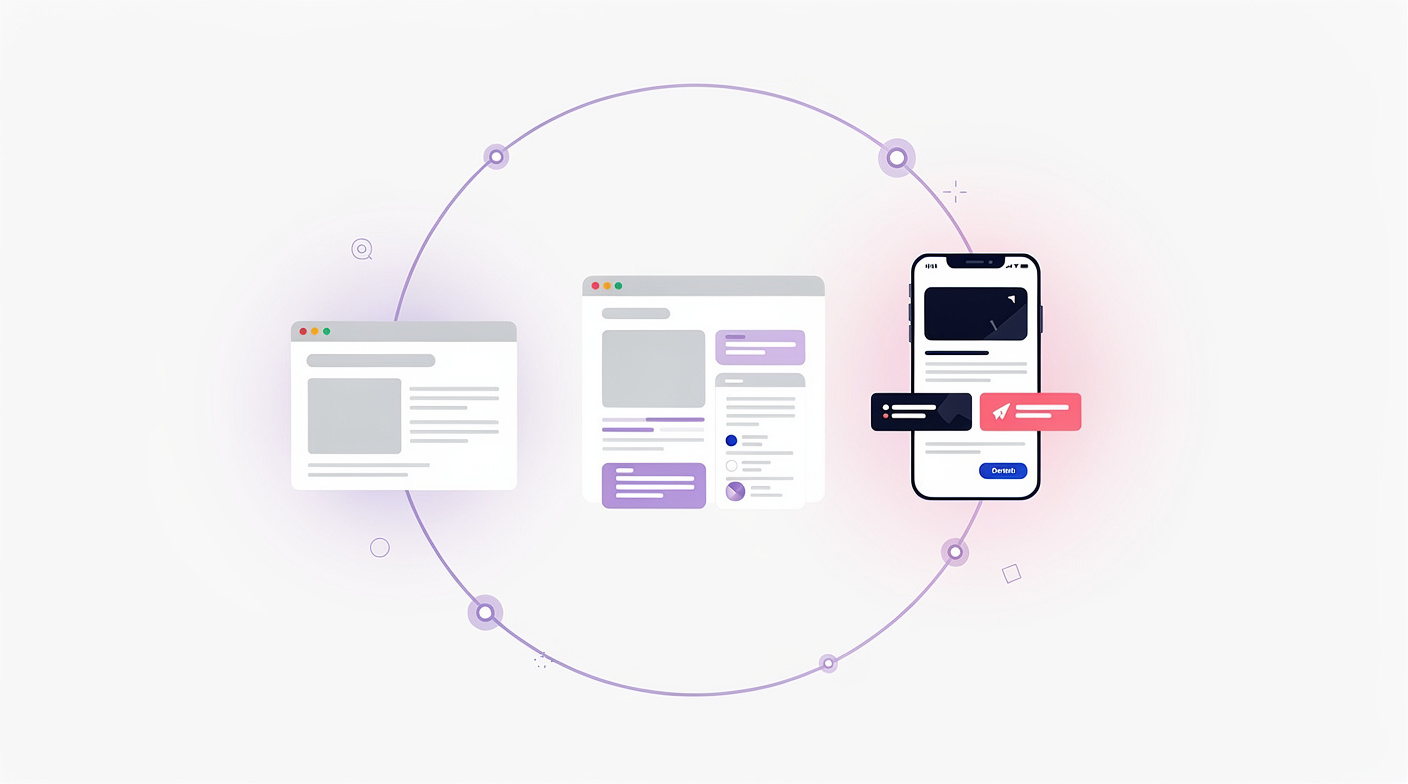
AI-generated illustration. Clearly non-photographic, stylized graphics like this do not require a visible label.

Image: AI-generated. A photorealistic image like this could be mistaken for a real photo, so it must be clearly labeled.
A photo-realistic image of a real, recognisable person or a real location that a viewer could believe is a genuine photograph.
An obvious illustration, abstract pattern, stylised 3D vector or clearly imaginary scene that nobody would take for a real photo.
When you do label an image on a website, the practical options are a caption or a small corner note such as "Image: AI-generated". On social media, add a note in the post itself or use the platform's own AI-content tags where they are offered.
What about watermarks and metadata?
Machine-readable provenance signals, such as C2PA metadata and watermarks, are designed to travel with a file so that platforms and viewers can tell how it was made. These signals should not be removed.
Many AI tools now embed invisible provenance data or a watermark when they create a file. That information helps the wider system stay honest even when a visible caption is missing. Stripping it out to hide a file's origin works against the transparency the rules are built on, so the safe habit is to leave it in place.
Do chatbots have to announce they are AI?
Yes. A chatbot or AI assistant that interacts with people must disclose that it is a machine right at the start of the interaction, for example with a line such as "I am an AI assistant." People should never be led to believe they are talking to a human when they are not.
This is one of the clearest obligations. If you add an AI chat widget to your site, make the disclosure part of the opening message rather than something a visitor has to dig for. A single honest sentence up front sets the right expectation and keeps you on the right side of the rule.
Does labelling apply to the site's technology or its content?
The AI Act's labelling duty is about the content that could mislead an audience: the actual words a reader reads, and realistic images or video that could be taken as genuine. It does not apply to the technical structure of a web page or to its code.
When a site is built with an AI-assisted tool such as Novavalo, the AI produces the technical frame: the layout, the blocks, the buttons, the HTML, the menus. That is scaffolding, not "content" in the sense the law means. Nobody needs a label saying a page's structure or code was made by a machine, just as we do not label a document because it was typed in a word processor, or a shelf because it was cut with a power drill.
Think of a house. The frame, the walls and the plumbing, which stand in for the page's technical structure and code, are built with machines and tools, and nobody glues a sticker on them reading "made with power tools". The labelling is about what is said and shown inside the house: the text a guest reads, and the photo-like images that could be mistaken for real. The law is about the message, not the scaffolding.
So in practice you do not need to label the fact that your site was built with an AI tool. Put your attention on what the page actually says and which images it shows. A fully AI-written piece on a matter of public interest with no human responsibility, or a photo-realistic AI image that could pass for a real photograph, are what fall under the labelling rules. The tool that generated the structure does not. With Novavalo it works exactly this way: the tool does the technical work, but you, the human, decide and answer for the page's content, and you can label images where needed.
At a glance: when to label AI content
Use this table as a quick reference. It is a summary of the principles above, not a substitute for the official text.
| Content type | Label required? | How |
|---|---|---|
| Blog or business text | No, if a human reviews and takes editorial responsibility | No label needed; add "This text was generated with AI" only if published unreviewed |
| Public-interest news, fully AI-written | Yes, required | Clear note at the start or end of the text |
| Realistic photo or image of a real subject | Yes, if it could be mistaken for real | Caption or corner note, e.g. "Image: AI-generated" |
| Illustration, graphic or stylised art | No, not required | No visible label needed |
| Chatbot or AI assistant | Yes, required | Disclose at the very start, e.g. "I am an AI assistant." |
How to label AI content correctly
A short routine keeps you transparent without turning every page into a disclaimer. Here is a practical checklist:
Transparency checklist
- Review the substance. Have a person check facts and approve AI-assisted text before it goes live, so a human carries editorial responsibility. This is more than a proofread.
- Judge images by realism. If a picture of a real person or place could pass for a genuine photo, label it. If it is clearly an illustration, it does not need a mark.
- Caption where needed. Use a plain caption or corner note such as "Image: AI-generated", and on social media use the platform's AI tags.
- Keep provenance data. Do not strip watermarks or C2PA metadata from AI files; let those signals travel with the content.
- Disclose chatbots up front. Make "I am an AI assistant" part of the assistant's opening message.
- Be honest with public-interest content. If a piece on health, safety, politics or law is fully AI-written and unreviewed, say so clearly.
Publish transparent, high-quality content with Novavalo
Novavalo helps you make content that is clear and honest. In practice that means:
- A human in the loop. You review and publish your own content, so a person keeps editorial responsibility for what goes out.
- Captions you control. Add your own image captions and notes wherever you want to be explicit about how a visual was made.
- Full control of your site. You manage the text, images and pages yourself, so nothing is published without your say-so.
Novavalo does not automatically fulfil legal obligations for you and does not add C2PA metadata itself. It gives you the tools to publish transparently and take responsibility for your content.
Build your site for free →Want to go deeper on how AI and humans divide the work? Read what AI actually does when it builds your website and metadata, and where a human is still needed. To understand how AI systems read and cite the content you publish, see our guide to GEO and AEO and how AI search finds you.
Frequently asked questions
Do I have to label AI-generated blog text on my business website?
Usually not, as long as a human reviews and approves the substance and takes editorial responsibility for what is published. That editorial check is the key exception in Article 50. Simple proofreading is not enough. If a text on a matter of public interest is published fully AI-generated with no such review, it should be clearly labelled.
Which AI images need a visible label?
Realistic or photo-like images of a real person, place or event that a viewer could mistake for genuine. That follows the deepfake principle: if it could be taken as real, mark it clearly, for example with a caption or a corner note. Obviously fictional or stylised visuals such as illustrations, abstract art or 3D vector graphics do not need a visible label.
Do chatbots have to say they are AI?
Yes. A chatbot or AI assistant that talks with people must disclose that it is a machine at the very start of the interaction, for example with a line like "I am an AI assistant." The point is that a person should never be led to believe they are talking to a human when they are not.
What is the editorial-responsibility exception?
When a person checks the substance of AI-assisted text, approves it and takes editorial and legal responsibility for it, as with most business and blog content, a machine-made label is not required. The reasoning is that a human, not the machine, is answerable for the content. This is different from a light proofread, which does not carry that responsibility.
Can I remove watermark or C2PA metadata from AI files?
No. Machine-readable provenance signals such as C2PA metadata or watermarks are meant to travel with the file so that platforms and viewers can tell how it was made. Stripping them out works against the transparency the rules are built on. Leave them in place.
Build a site you can stand behind
Create clear, honest pages you review and publish yourself. No sign-up, no code, no payment card.
Start for free →Read next
Trusted sources
- EUR-Lex: Regulation (EU) 2024/1689 (AI Act) official - the official text of the regulation.
- European Commission: AI Act official - the Commission's official information page.
- AI Act, Article 50 official - the text of Article 50 on transparency obligations.
- C2PA standard - the content provenance and authenticity standard behind machine-readable labels.
Transparency note: This article was produced with the assistance of AI, and Novavalo's editorial team is responsible for its content.