GUIDE · WEB HISTORY
The history of websites: from static HTML to WordPress to building sites with AI
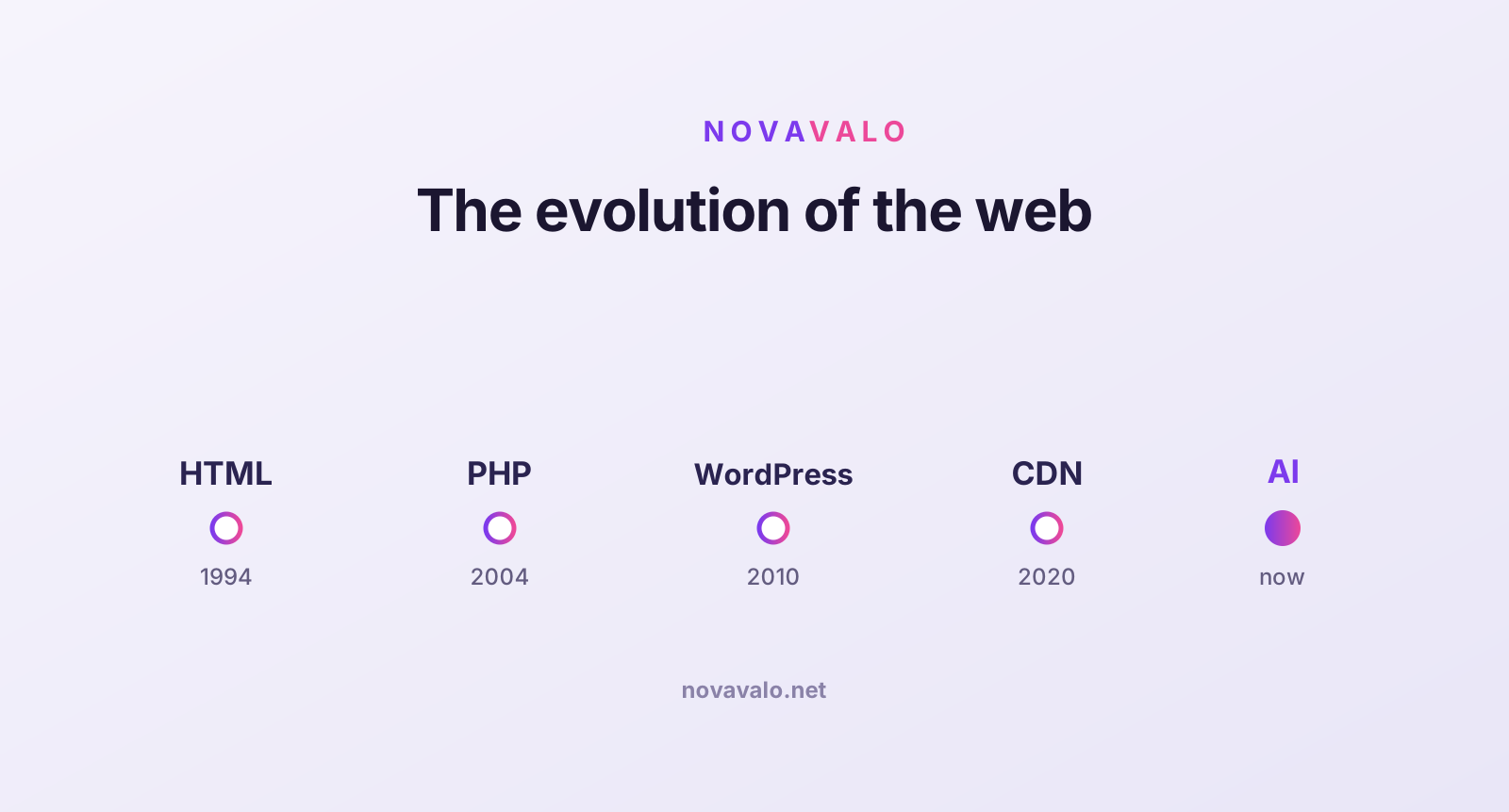
The story of the website is a loop, not a straight line. It began with simple, hand-coded pages that were fast and secure by default. It grew into vast content systems that could do almost anything, and pay for it in maintenance. Now it is circling back to speed and simplicity, this time with AI doing the building. Here is the whole arc, and where it leaves a small business today.
Websites started as static HTML files in the 1990s: no database, no login, just a page the server handed over as written. CGI and PHP then made the web dynamic, and WordPress turned that power into easy publishing for everyone, at the cost of plugins, updates and security upkeep.
In the 2020s the pendulum swung back. The modern static approach, JAMstack on a global CDN, brought back the old speed and safety, and AI now generates the pages, the content and the metadata from a short description.
Novavalo sits at the end of that arc: AI builds and optimises the content, the pages stay fast and secure as static files on a CDN, and the result is visible to both search engines and AI answer engines.
What were the first websites like?
The web began in 1991 with a single page. Tim Berners-Lee, working at CERN, wrote the first website by hand: a plain document that explained what this new thing called the World Wide Web was. It had no images, no colours to speak of and no database behind it. It was a file, and the server sent that file to the browser exactly as written.
For most of the 1990s, that was the whole model. A website was a set of static HTML pages, each one hand-coded in a text editor and uploaded to a server. If you wanted to change the opening hours, you opened the file, edited the text and uploaded it again. There was no login, no admin panel and no moving parts. What you wrote was what visitors saw.
This simplicity had real strengths that are easy to forget. A static page loaded almost instantly, because the server did not have to assemble anything. It was secure by default, because there was no database to break into and no login to attack. And it did not break on its own, because nothing was running in the background that could crash. The trade-off was convenience: every change meant editing raw code, which put websites out of reach for people who were not comfortable with HTML.
The short answer: the first websites were hand-coded static HTML files. They were fast, secure and stable, but you needed to write code to change anything, so the web was not yet open to everyone.
How did CGI and PHP make the web dynamic?
As the web grew, static pages started to feel limiting. People wanted guestbooks, contact forms, search boxes and pages that could show different content to different visitors. A page that never changed on its own could not do any of that. So the web learned a new trick: generating pages on the fly.
The first widely used approach was CGI, a way for a web server to run a small program and send its output back as a page. Soon after, in the mid to late 1990s, PHP arrived and made this far easier. With PHP, a page could talk to a database, read what a visitor typed into a form, and build a fresh response every single time it was loaded. The web went from a library of fixed documents to something closer to software.
This was a genuine leap. Suddenly a website could remember things, react to input and pull content from a database rather than from a hand-edited file. Online forums, early shops and news sites all became possible. But the leap came with a new cost that would define the next two decades: a dynamic site was no longer just a file. It was a running program, a database and a server that all had to keep working together, and all of it had to be kept up to date and secure.
The trade-off that shaped everything after
From this point on, every website design has really been a choice about the same trade-off. A dynamic, database-driven site is flexible and can do almost anything, but it is a machine that needs tending. A static, pre-built site does less, but it is fast, safe and almost maintenance-free. The rest of web history is the pendulum swinging between those two poles.
Why did WordPress take over the web?
By the 2000s, dynamic sites were powerful but still awkward to build. You either hired a developer or learned PHP yourself. What ordinary people wanted was the power of a dynamic site without the code. That gap is exactly what content management systems filled, and one of them, WordPress, came to dominate.
WordPress started in 2003 as blogging software and grew into a general-purpose website platform. Its promise was irresistible: log into a friendly admin panel, write your content in a box that looked a bit like a word processor, pick a theme for the design, and add features by installing plugins. No code required. You could have a blog, a business site or a small shop without ever opening an HTML file. It is not hard to see why WordPress ended up powering a huge share of the world's websites.
But the WordPress model quietly reintroduced every cost of the dynamic era, and multiplied it. A typical WordPress site is a stack of independently maintained parts: the core software, a theme, a page builder and often a dozen or more plugins, each written by different people on different schedules. Every page load assembles the page anew from a database. And every one of those parts needs updating, both for new features and for security patches.
Each page is built on the fly from a database, a theme and many plugins. Updates arrive constantly and can conflict with one another. There is a login page, a database and a plugin surface for attackers to probe. A simple text change can mean the right plugin, the right setting and a backup just in case.
Each page is a pre-built file delivered as-is. There is no database or plugin stack running on every visit, so there is far less to break, update or defend. The page loads fast, stays secure and looks the same next week as it does today, with no maintenance ritual.
None of this makes WordPress bad software. For a large, deeply customised platform it is genuinely strong. But for an ordinary small-business site, the maintenance burden it brings is the reason we wrote a whole piece on why we left WordPress behind: the pieces stop fitting together, and the page tends to break at the worst possible moment. The power was real, and so was the weekly upkeep.
Why is static making a comeback?
Here is where the loop closes. After a decade of heavy, database-driven sites, the industry started to notice that the old static model had been right about a lot of things. Pages were getting slower and harder to secure, and much of that weight existed only to serve content that barely changed from one visit to the next. Why rebuild a homepage from a database on every single load if it says the same thing all day?
The answer was a modern take on static, often called JAMstack. The idea is to pre-build the pages ahead of time and serve them as plain files from a content delivery network, a CDN, which is a global network of servers that keep copies of your page close to visitors everywhere. When someone opens the site, the nearest server hands over a ready-made file in a fraction of a second. Dynamic features like forms or bookings still work, but they run as separate, focused services rather than as plugins bolted onto every page.
This brings back the best of the 1990s without the pain. A modern static site is fast, because nothing is assembled on the fly. It is secure, because the familiar attack surface of a login, a database and a plugin stack is simply not there. And it is stable, because there is no background process to crash on a Friday afternoon. What changed since the early web is the tooling: you no longer have to hand-code the HTML to get these benefits.
What the modern static approach brings back
- Speed by default. Pre-built files on a CDN load almost instantly, with nothing to assemble per visit.
- A small attack surface. No login, no database and no plugin stack means fewer routes for intruders and spam.
- No maintenance ritual. There is no weekly cycle of core, theme and plugin updates to keep the lights on.
- Stability. The page looks the same next month as it does today, with no version conflicts.
- Modern editing. Unlike the 1990s, you change content in a friendly editor, not in raw HTML.
How is AI changing how websites are built?
The static comeback solved the how-it-runs problem. The remaining problem was always the same one that made WordPress so popular: building the thing in the first place, and writing all the content, is a lot of work. That is the problem AI is now solving. This is the newest turn in the story, and it changes who does the building.
Modern AI site builders can take a short description of your business, your field, your style, what you offer, and generate a complete first version of a website: the structure, the sections, the copy and even the images. Crucially, AI also writes the parts that used to be an afterthought, like page titles, meta descriptions and structured data. If you want an honest look at how far this goes and where a human still has to step in, we covered exactly that in AI builds your website and metadata, and where it falls short. The heavy groundwork drops from days to minutes; the facts, brand voice and strategy still need you.
There is a second, subtler shift happening at the same time. For thirty years, websites were written for two audiences: human readers and search engine crawlers. Now there is a third: AI answer engines like ChatGPT, Gemini and Perplexity, which read your pages, summarise them and recommend businesses directly. Writing so that machines can understand, cite and quote you is a discipline of its own, sometimes called GEO or AEO, and we walk through it in how AI search finds you. The upshot is that content now has to be clear and well-structured not just for people, but for the models that increasingly stand between your business and its customers.
The short answer: AI now builds the site, writes the content and generates the metadata from a short brief, and it writes that content so both search engines and AI answer engines can understand it. The human's job shifts from typing everything to checking the facts and steering the direction.
This matters most for the people the earlier eras left behind. A hand-coded static site in 1995 needed a coder. A WordPress site in 2015 needed someone willing to maintain it. An AI-built static site in 2026 needs neither. Whether you are starting a business and need a homepage this week, or launching an online store, the barrier that defined the whole history of the web, needing either code skills or ongoing upkeep, is largely gone.
See where the history lands: build a site with AI
On novavalo.net you describe your business, and AI builds a complete site for you: fast, static and ready to publish. It is the end of the arc in this article, from hand-coded HTML to a homepage that writes and optimises itself.
- Tell it your field and your style, and AI proposes a finished page
- Edit the text and images straight in the browser, no HTML required
- Publish as a fast static site with no plugins to maintain
Where does Novavalo fit in this history?
Read the whole arc and a pattern jumps out. Each era traded one thing for another. Static HTML gave speed and safety but demanded code. Dynamic PHP and WordPress gave power and easy publishing but demanded maintenance. The modern static comeback gave back speed and safety, and AI gave back the ease of building. Novavalo is built to hold all of those gains at once, and drop the trade-offs.
Here is how the pieces line up. AI does the building and the writing, so you do not need to code and you do not start from a blank page, the way the earliest web demanded. The output is a static site on a CDN, so your pages stay fast and secure with no plugins, no database and no weekly update ritual, the way the WordPress era demanded. And the content is written for machines as well as people, so you are visible in both traditional search and the new AI answer engines, which the next era will demand of everyone.
In other words, Novavalo is not a rejection of web history. It is the sum of it. It keeps what each era got right, the raw speed and security of static, the accessibility of easy publishing, the intelligence of AI, and leaves behind what each era got wrong, the need to hand-code, and the need to endlessly maintain. For an ordinary small business, that is the point the whole story has been heading toward: a site that is fast, secure, easy to build and easy to find, without you having to become either a developer or a system administrator to keep it alive.
Frequently asked questions
What was the first website?
The first website went live in 1991 at CERN, built by Tim Berners-Lee. It was a plain, hand-coded static HTML page with no database, no images and no styling beyond simple links. Every early website worked the same way: a file that the server sent to the browser exactly as written.
What is the difference between a static site and WordPress?
A static site is a pre-built file delivered to the visitor as-is, with no database or plugins running on each visit, so it loads fast and has a small attack surface. WordPress assembles each page on the server from a database, a theme and plugins, which adds flexibility but also maintenance, updates and security work.
Can AI build a whole website?
Yes. Modern AI site builders generate the structure, the copy, the images and the metadata from a short description of your business. A human still checks the facts, the brand voice and the strategy, but the heavy groundwork of a first version is done in minutes rather than days.
Are static websites making a comeback?
They are. The modern static approach, often called JAMstack, pairs pre-built pages with a global content delivery network. It brings back the speed and security of the early web while keeping the convenience of a browser-based editor, which is why many small-business sites are moving back to static.
Why does website speed matter for search?
Search engines measure loading speed, responsiveness and visual stability as part of page experience, and both search engines and AI answer engines favour pages that load quickly and are easy to parse. A lightweight static page has a structural advantage over a heavy, plugin-laden one.
From hand-coded HTML to a site that builds itself
You have read thirty years of web history. Now let AI build your business a fast, secure site in a few minutes, the modern end of the whole story.
Start for free →Read next
Trusted sources
- W3C: A Little History of the World Wide Web official - the World Wide Web Consortium's own account of how the web began, including the first server and pages at CERN.
- MDN Web Docs: Getting started with the web official - Mozilla's documentation on how HTML, static pages and the modern web fit together, maintained by the people who help define web standards.
- web.dev: Core Web Vitals official - Google's engineering guidance on page loading speed, responsiveness and visual stability, the metrics where a lightweight static page has the advantage.
- Google Search Central official - Google's official documentation on how sites are crawled, indexed and ranked, including the role of page experience.