Visibility · GEO / AEO
Write content for the bots too: GEO/AEO and how AI search finds you
More and more people no longer Google. They ask ChatGPT, Gemini or Perplexity. If your pages aren't written for machines as well, you'll be left out of their answers entirely. Here's how to make sure AI finds, understands and recommends your business.
AI search tools answer a question with one response drawn from a few sources instead of ten blue links. GEO (Generative Engine Optimization) and AEO (Answer Engine Optimization) make sure your business is one of those cited sources.
The recipe is practical: question-style headings, a concise answer in the first sentence, key facts (name, location, services, prices, hours) written as text, an FAQ section, structured data and plain language.
These same changes also make pages clearer for people and stronger for traditional SEO, so you optimise once and gain everywhere.
What do GEO and AEO mean?
GEO (Generative Engine Optimization) means optimising content for AI search: ChatGPT, Gemini, Perplexity and Google's AI Overviews. AEO (Answer Engine Optimization) means shaping content so it works as a direct answer to a question. The goal is the same: when someone asks an AI for the "best barber in Manchester", your business is in that answer.
Traditional search engine optimisation (SEO) aims for a ranking on Google's results page. But AI search doesn't show ten blue links. It gives one answer. So it's not enough for your pages to be findable; they have to be the source the model reads and cites.
Why does this matter right now?
Search behaviour is changing faster than ever. A growing share of the questions people ask before a purchase go straight to an AI, which boils the answer down to a handful of sources. If you're not among those sources, you're effectively invisible, no matter how well you rank in traditional Google.
The good news: the same things that make your pages AI-friendly also make them clearer for people and better for traditional SEO. So you're not optimising in two directions. You're doing one thing properly.
How do you write content for the bots too?
A language model draws its answers from short, self-contained, fact-based snippets of text. In practice, that means six things:
GEO/AEO checklist
- Question headings. Phrase your subheadings as questions your customers actually ask ("How much does wedding photography cost?").
- Answer immediately. Give a concise, self-contained answer in the first sentence, with no lead-in and no "read more below".
- State the facts. Business name, location, services, prices and opening hours clearly in text, not just in an image.
- FAQ section. Gather the most common questions and answers. This is the easiest content for an AI to pick up.
- Structured data. Mark up your business, services and FAQ with machine-readable schema data.
- Plain language. Short sentences and unambiguous terms, because the model won't guess what you meant.
The same question before and after optimisation
The difference is immediate. Picture a hair salon asking an AI whether it would recommend the business:
"I can't find precise information about this business. The site has images and a slogan, but no clear details about its services or location."
"Yes. A hair salon in central Manchester, specialising in colour work. Cuts from £45, online booking available. Open Mon to Fri, 9am to 6pm."
From a marketing point of view, the content barely changed. It simply became machine-readable. Same information, right format.
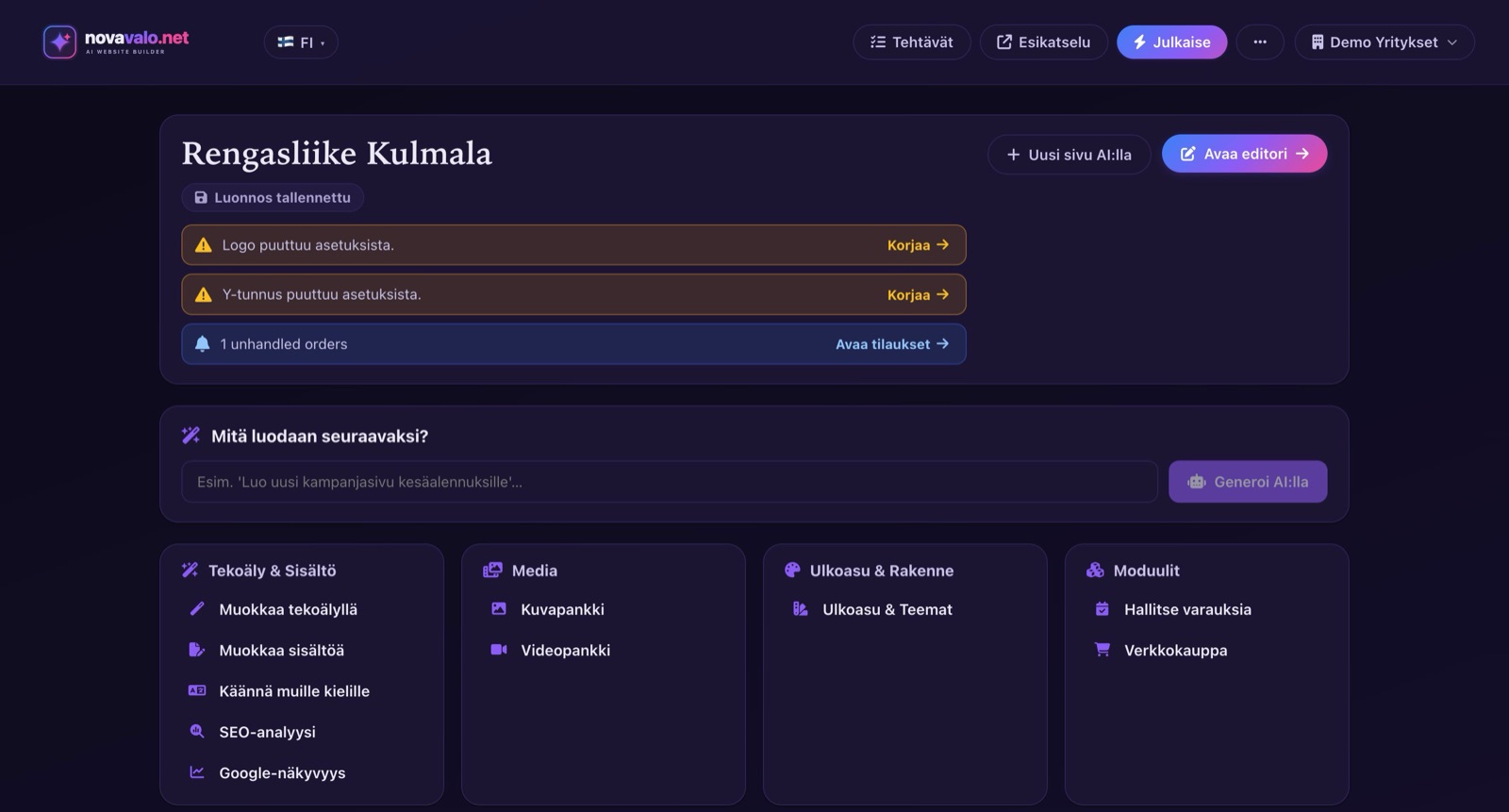
Test your AI visibility: Novavalo's GEO/AEO tool
You don't have to guess whether your business shows up in AI search. Novavalo's built-in GEO/AEO tool does it for you:
- Asks AI search the right questions for your industry and area, and shows whether your business appears in the answers.
- Explains in plain language what the AI says about you, where you're strong and what's missing from your pages.
- Compares before and after: see how the same query changes once the content is optimised.
- Creates ready-made fix tasks that the AI can also carry out for you: not just a report, but concrete actions.
Novavalo also builds your pages with AI search in mind from the start: it writes customer-focused copy, suggests question-style headings and adds structured data automatically. Once the foundation is right, the GEO/AEO tool handles the fine-tuning. Read more about what AI actually does when it builds your website, and where a human is still needed.
Frequently asked questions
Is GEO/AEO different from search engine optimisation (SEO)?
Partly. SEO aims for a ranking on Google's results page, while GEO/AEO is about getting an AI to cite you in its answer. The good news is that the same fundamentals help with all of them: plain language, facts as text, question headings and structured data.
Can I influence what ChatGPT or Gemini says about my business?
Yes. Language models read your public content. When your pages have clear, fact-based answers, the model picks them up. If the information is only in images or vague slogans, the model won't find it, or it will make something up.
How quickly do changes show up in AI search?
Structural improvements (question headings, FAQ, facts, schema) take effect as soon as the AI next reads your page. With Novavalo's GEO/AEO tool, you can see the before-and-after difference for yourself.
Do I really need structured data (schema) for AI search?
It helps a lot. Schema spells out your business, services and FAQ in a machine-readable form, which removes guesswork for the model. Plain, factual text still matters most, but structured data makes those facts easier to read and trust.
Which pages should I optimise first?
Start with the pages that answer buying questions: your services, pricing and contact or booking pages. Add clear facts, a short answer at the top and an FAQ, then let the changes spread to the rest of the site.
Does Novavalo handle GEO/AEO for me?
Largely, yes. Novavalo writes customer-focused copy, suggests question-style headings and adds structured data automatically. The built-in GEO/AEO tool then checks whether your business shows up in AI answers and creates fix tasks it can carry out for you.
Try it yourself, for free
Build pages optimised for AI search and run a visibility analysis. No sign-up, no code, no payment card.
Start for free →Read next
Trusted sources
- Google Search Central documentation official - Google's own guidance on how search and AI Overviews read and rank your pages.
- Schema.org official - the shared vocabulary for structured data that makes your business, services and FAQ machine-readable.
- Google FAQ structured data guide official - how to mark up an FAQ section so search and AI can pick up your questions and answers.
- web.dev: Core Web Vitals official - Google's reference for the page-quality and performance signals behind a fast, findable site.